




Chevrolet Diesel Diagnostic Service
in Livingston
Finding the Cause of a Diesel Problem — Not Just Reading a Code
When something isn't right with your Chevrolet diesel truck, the first step is finding out why.
A Check Engine Light, warning message, loss of power, hard starting, unusual exhaust, or poor performance can have many possible causes. Modern Duramax diesel engines combine sophisticated fuel, air, turbocharger, emissions, electronic, and mechanical systems. A problem in one system can sometimes produce symptoms that appear to come from another.
That's why proper diesel diagnostics involve more than connecting a scan tool and reading a trouble code.
A diagnostic code is not the diagnosis.
At Jason Lewis Chevrolet in Livingston, TN, our service technicians use diagnostic information, physical inspection, testing, and their knowledge of diesel systems to identify the cause of a problem and determine what should be done next.
Have a diesel problem? Call Jason Lewis Chevrolet Service at 931-228-5279.
What Is Chevrolet Diesel Diagnostic Service?
Diesel diagnostic service is the process of identifying the cause of a performance problem, warning light, fault code, or other unusual condition affecting your Chevrolet diesel truck.
The diagnostic process can involve electronic scans, visual inspection, system testing, and mechanical verification. The exact steps depend on what your truck is experiencing and what the initial findings reveal.
For example, reduced engine power could potentially be related to fuel delivery, air intake, turbocharger operation, an emissions system, an electronic sensor, or an underlying mechanical problem.
Good diagnosis means following the evidence to the cause.
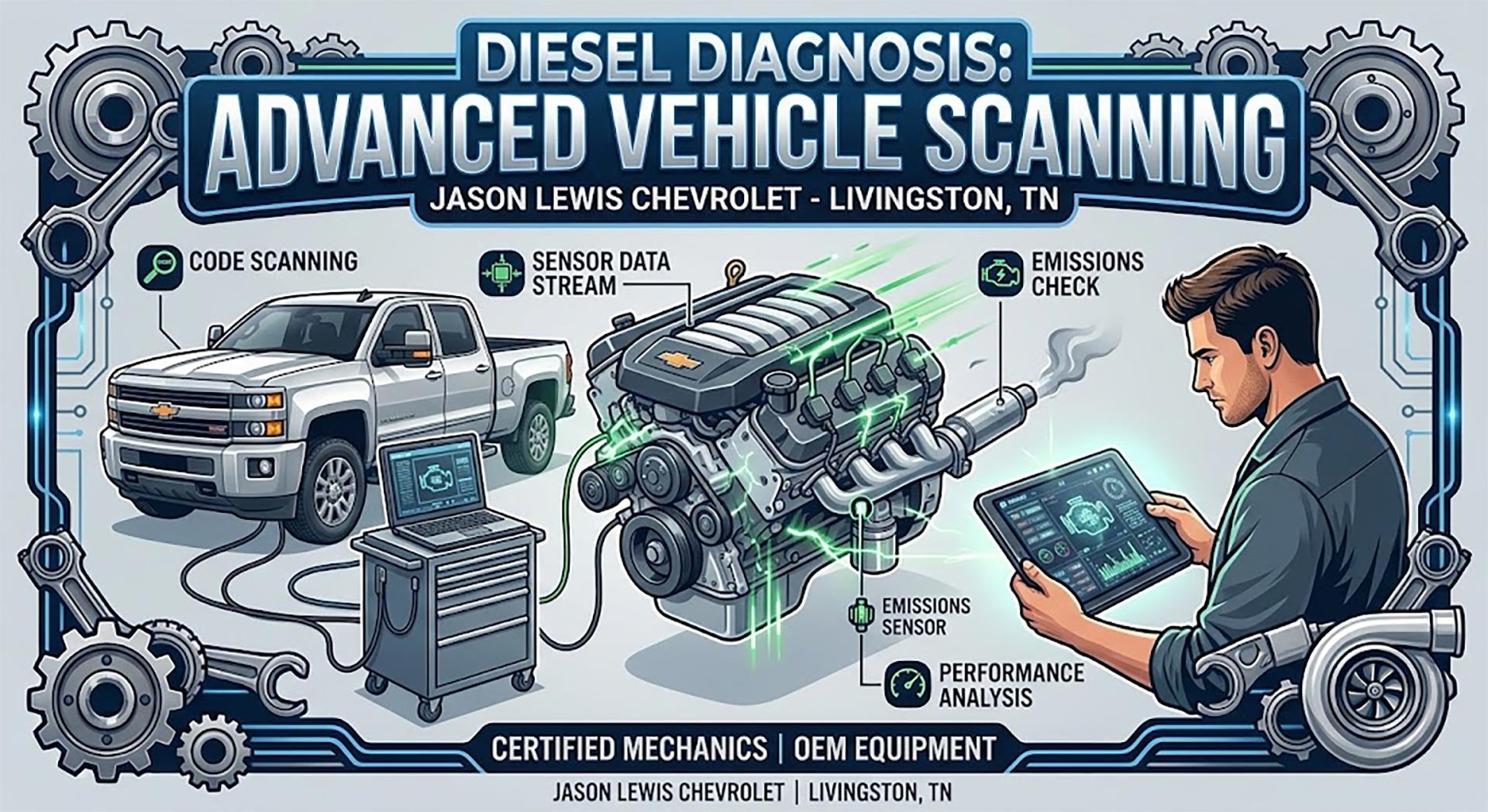
How We Diagnose a Chevrolet Diesel Problem
Every diagnostic problem is different. A technician doesn't necessarily perform every test on every vehicle. Instead, the diagnostic process develops according to the symptoms, vehicle information, and test results.
1. Symptom Verification and Electronic Scanning
The process begins by understanding what you are experiencing.
- When did the problem begin? Does it occur when starting, accelerating, towing, or driving at highway speeds? Has a warning light appeared? Has the truck entered a reduced-power or restricted operating mode?
- The technician can then use appropriate diagnostic equipment to communicate with the vehicle's electronic systems and look for stored diagnostic trouble codes and other information.
- A code provides an important clue—but it doesn't automatically identify the failed component.
2. Visual and Physical Inspection
Electronic information is only part of the story.
A technician may inspect the engine compartment and related systems for conditions such as:
- Fluid leaks
- Damaged or disconnected hoses
- Loose connections
- Wiring or connector problems
- Air-intake restrictions
- Fuel-system concerns
- Exhaust-system damage
- Signs of overheating
- Other visible conditions that could contribute to the problem
Sometimes a physical inspection reveals an obvious problem. Other times, it helps determine which additional tests are appropriate.
3. Fuel System Testing and Diagnosis
The fuel system is critical to diesel engine performance.
A modern Duramax uses a sophisticated high-pressure fuel-injection system. Problems involving fuel quality, filtration, fuel delivery, pressure, injectors, sensors, or other fuel-system components can affect starting, power, fuel economy, and engine operation.
Depending on the symptoms and diagnostic findings, technicians may perform appropriate fuel-system tests to determine whether the system is operating within specifications.
4. Air Intake and Turbocharger Diagnosis
A diesel engine needs the right combination of fuel and air to produce power efficiently.
The turbocharger and air-intake system play an important role in supplying the engine with the air it needs.
Depending on the problem, technicians may investigate:
- Air-intake restrictions
- Leaks
- Turbocharger operation
- Boost pressure
- Related sensors
- Hoses and connections
- Other components affecting air delivery
A problem with air delivery or turbocharger operation can produce symptoms such as reduced power, poor acceleration, unusual noises, or other performance concerns.
5. Emissions and Aftertreatment Evaluation
Modern Chevrolet diesel trucks use sophisticated emissions systems, including components associated with the Diesel Particulate Filter (DPF), Selective Catalytic Reduction (SCR), and Diesel Exhaust Fluid (DEF).
When an emissions warning appears, the underlying cause needs to be identified rather than simply clearing the warning.
Depending on the vehicle and symptoms, diagnostic work may involve evaluating system data, sensors, regeneration operation, DEF-related conditions, and other components of the aftertreatment system.
Ignoring an emissions-system problem can potentially lead to reduced performance or a restricted operating mode.
6. Mechanical Health Verification
Sometimes electronic and system testing points toward an underlying mechanical problem.
When appropriate, additional testing can help determine whether the engine itself is operating properly.
Mechanical problems can sometimes produce symptoms that resemble fuel, air, turbocharger, or electronic problems. That's why a thorough diagnosis doesn't stop when a code is found.
The objective is to determine the root cause of the problem before recommending a repair.
Why Proper Diesel Diagnosis Matters
Replacing parts based only on a diagnostic code can be an expensive way to repair a vehicle.
A fault code may identify a system or condition that requires further investigation. It does not always mean that the component associated with the code is the actual cause of the problem.
Proper diagnosis can help:
- Identify the underlying cause
- Avoid unnecessary parts replacement
- Determine which system requires attention
- Identify problems before they become more serious
- Give you a better understanding of the repair being recommended
For a truck that you depend on for work, towing, or everyday transportation, finding the problem correctly matters.
Signs Your Chevrolet Diesel May Need Diagnostics
You don't have to wait for a major failure before having your truck checked.
Consider scheduling a diagnostic inspection if you notice:
What Is Chevrolet Diesel Diagnostic Service?
Diesel diagnostic service is the process of identifying the cause of a performance problem, warning light, fault code, or other unusual condition affecting your Chevrolet diesel truck.
The diagnostic process can involve electronic scans, visual inspection, system testing, and mechanical verification. The exact steps depend on what your truck is experiencing and what the initial findings reveal.
For example, reduced engine power could potentially be related to fuel delivery, air intake, turbocharger operation, an emissions system, an electronic sensor, or an underlying mechanical problem.
Good diagnosis means following the evidence to the cause.
- Check Engine Light
- Reduced engine power
- Hard starting
- Rough engine operation
- Poor acceleration
- Unusual exhaust smoke
- Declining fuel economy
- Unusual turbocharger noises
- Overheating
- Transmission performance concerns
- DPF warning
- DEF warning
- Other diesel-system warning messages
- A noticeable change in how your truck drives
If a warning light appears, don't assume that clearing the code solves the problem. The important question is why the warning appeared in the first place.
Diesel Diagnostics for the Way You Use Your Truck
How you use your Chevrolet diesel can provide important clues when diagnosing a problem.
A truck that regularly tows heavy trailers operates under different conditions than one primarily used for commuting. Frequent towing, heavy hauling, extended idling, short trips, and other demanding conditions can affect diesel systems differently.
That's why we want to understand not only what the truck is doing, but also how you use it.
The more information you can provide about the symptoms, the conditions under which they occur, and when they began, the more useful that information can be to the diagnostic process.
Why Choose Jason Lewis Chevrolet for Diesel Diagnostics?
Your Chevrolet diesel truck is a sophisticated piece of equipment.
When something goes wrong, you want more than a computer-generated code. You want someone to investigate the problem and determine what the vehicle is telling you. At Jason Lewis Chevrolet in Livingston, our service department works on the Chevrolet diesel trucks we sell. We understand that diesel engines use systems and components that differ substantially from gasoline-powered vehicles. Our approach is straightforward: Listen to the customer. Investigate the symptoms. Test the systems. Find the cause. Then explain what the vehicle needs.
That's what proper diagnosis is about.
Frequently Asked Questions
(Click + for the answer)
Not necessarily. A diagnostic code is an important clue, but it does not always identify the failed component or the root cause of the problem. Additional inspection and testing may be necessary to determine what is actually happening.
There can be many reasons a Check Engine Light may illuminate. The cause could involve the engine, fuel system, air delivery, emissions system, sensors, or another vehicle system. The light needs to be properly diagnosed rather than assuming the cause based only on the warning.
Yes. Reduced power can have several possible causes, including fuel delivery, air intake, turbocharger operation, emissions-system conditions, electronic controls, or other problems. Proper diagnosis helps determine where the problem originates.
A DPF warning can occur when the diesel particulate filter or related system requires attention. The appropriate response depends on the warning, the vehicle, and the underlying condition. If the warning persists or additional warnings appear, professional diagnosis may be necessary.
DEF is Diesel Exhaust Fluid used by the emissions system on many modern Chevrolet diesel trucks. Problems involving DEF or the related emissions system can result in warning messages and, under certain circumstances, restricted vehicle operation.
It depends on the warning and how the truck is operating. Some warnings require immediate attention, while others may allow you to drive to a service facility. If the vehicle is overheating, losing substantial power, operating abnormally, or displaying a serious warning, stop driving when it is safe to do so and seek assistance.
Heavy towing places additional demands on the engine, transmission, cooling system, and other components. If a problem occurs primarily while towing or under heavy load, tell the technician. That information can be an important part of the diagnostic process.
There is no single answer. Some problems can be identified quickly, while others require additional testing to isolate the cause. The time required depends on the symptoms, diagnostic findings, and complexity of the problem.
No. If a warning light is on or your truck isn't operating normally, simply tell us what you have noticed. Our technicians can perform the appropriate diagnostic process.
Yes. Jason Lewis Chevrolet in Livingston services the Chevrolet diesel trucks we sell. If your Duramax is experiencing a warning light, performance problem, unusual noise, or another concern, our service team can help determine what is causing it.
Don't Guess at a Diesel Problem
A warning light is a message. A diagnostic code is a clue. The goal of diesel diagnostics is to find the cause. If your Chevrolet diesel isn't performing the way it should, bring it to Jason Lewis Chevrolet in Livingston, TN and let our service team investigate the problem.
Call Jason Lewis Chevrolet Service at Call 931-228-5279 to schedule diesel diagnostic service.