




Section 179 Tax Deduction: A Guide to Qualifying Chevrolet Silverado Trucks and Express Vans
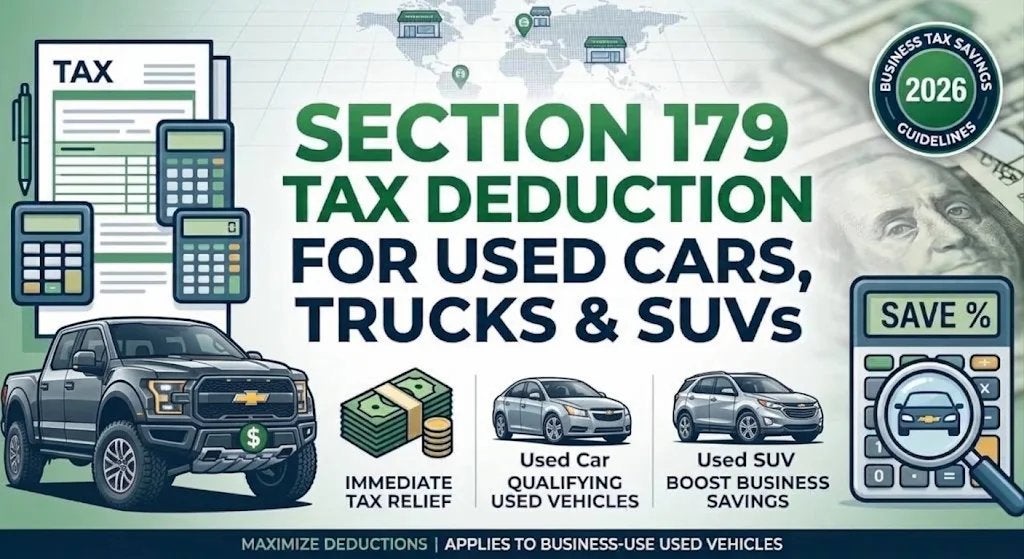
A Chevrolet work truck or commercial van may do more than help your business get the job done. It may also qualify for valuable federal tax deductions.
If you own a business, you may be able to deduct some or all of the cost of a qualifying vehicle through Section 179 of the Internal Revenue Code. For businesses that depend on dependable transportation, equipment hauling, job-site access, or commercial deliveries, a Chevrolet Silverado or Express van may be worth considering.
At Jason Lewis Chevrolet in Livingston, Tennessee, we want business owners to have the information they need when choosing a vehicle. Understanding Section 179 can help you have a more informed conversation with your tax professional before making a purchase.
Let's look at how the deduction works, which Chevrolet vehicles may qualify, and what you should know before making a decision.
What Is the Section 179 Tax Deduction?
Section 179 allows eligible businesses to deduct the cost of certain qualifying equipment and vehicles during the year the property is placed in service, rather than depreciating the entire cost over several years.
In practical terms, this may allow a business to deduct a significant portion of the purchase price of a qualifying work vehicle in the year it begins using that vehicle for business.
The deduction is designed to help businesses invest in the equipment and vehicles they need to operate and grow.
However, Section 179 is subject to several requirements and limitations. The vehicle must qualify, the business-use percentage must meet IRS requirements, and the business must have sufficient taxable income to use the deduction.
Which Chevrolet Vehicles May Qualify?
Chevrolet offers several trucks and commercial vans that businesses use every day. Depending on the vehicle's configuration and how it is used, certain Silverado and Express models may qualify for Section 179 treatment.
Two important Chevrolet vehicle families to consider are the Silverado lineup and Chevrolet Express vans.
Chevrolet Silverado: Built for Business
The Chevrolet Silverado is used by contractors, construction companies, farmers, landscapers, service businesses, and other professionals who need a capable truck.
Depending on the configuration, a Silverado can provide the towing capability, payload capacity, and cargo space needed to transport tools, materials, equipment, and supplies.
Potential business-use applications include:
- Construction and contracting
- Landscaping and property maintenance
- Agriculture and farming
- Plumbing, electrical, and HVAC services
- Equipment and material transportation
- Commercial service and delivery work
Silverado 1500, 2500 HD, and 3500 HD
The Silverado 1500 offers a range of configurations for businesses that need a versatile full-size pickup. The Silverado 2500 HD and 3500 HD provide additional capability for demanding commercial applications.
For tax purposes, the truck's actual configuration matters. Gross vehicle weight rating (GVWR), cargo-bed dimensions, and other vehicle characteristics can affect how the IRS classifies it and which deduction limitations apply.
Some qualifying pickups may fall outside the special Section 179 limit for heavy SUVs. However, not every Silverado configuration automatically qualifies for the same treatment.
Your tax professional should review the specific vehicle before determining the available deduction.
Chevrolet Express: A Practical Commercial Van
The Chevrolet Express is designed for businesses that need enclosed cargo space, passenger capacity, or a platform for specialized commercial equipment.
Depending on the configuration, Express vans can serve businesses such as:
- Contractors and construction companies
- Plumbing and electrical service providers
- HVAC companies
- Delivery and transportation businesses
- Mobile service operations
- Businesses that transport employees, tools, and equipment
Express Cargo Van
The Express Cargo Van provides an enclosed area for tools, supplies, and equipment. Its commercial design and available weight ratings may make certain configurations eligible for favorable business vehicle tax treatment.
Express Passenger Van
The Express Passenger Van is designed to transport groups of people. Its seating capacity and vehicle classification may affect how the IRS rules apply.
As with the Silverado, eligibility depends on the exact vehicle, its configuration, business use, and applicable tax requirements.
Important Section 179 Requirements
Buying a Chevrolet for your business does not automatically make the vehicle eligible for a Section 179 deduction.
The IRS establishes requirements that must be met.
1. The Vehicle Must Be Used More Than 50% for Business
Generally, the vehicle must be used more than 50% for qualified business purposes during the tax year it is placed in service.
For example, if a business owner uses a truck 80% for business and 20% for personal transportation, only the business-use portion of the vehicle's cost is considered when calculating the potential deduction.
The business-use percentage must be documented.
2. The Vehicle Must Be Placed in Service During the Tax Year
The vehicle must be ready and available for business use during the tax year for which the deduction is claimed.
Simply ordering a vehicle or making a deposit does not necessarily satisfy this requirement.
For a business claiming a deduction for the 2026 tax year, the vehicle must generally be placed in service by December 31, 2026.
3. The Vehicle Must Meet IRS Property Requirements
The vehicle must meet the applicable IRS requirements for qualifying property.
Certain used vehicles may qualify, provided they meet the IRS rules. For example, the vehicle generally must be new to the taxpayer, acquired from an unrelated party, and not previously used by the taxpayer.
4. The Business Must Meet Applicable Income and Deduction Limits
Section 179 has annual deduction limits and a taxable-business-income limitation.
The amount a business can deduct may depend on its income, the cost of other qualifying equipment purchased during the year, and the vehicle's classification.
These requirements are important when determining the actual tax benefit.
Understanding the 2026 Section 179 Deduction Limits
For tax years beginning in 2026, the IRS provides the following general Section 179 limits:
- Maximum Section 179 deduction: $2,560,000.
- Investment phaseout threshold: $4,090,000. The maximum deduction is reduced when qualifying property placed in service during the year exceeds this amount.
- Heavy SUV deduction limit: $32,000 for qualifying sport utility vehicles placed in service during 2026.
The $2,560,000 figure is the general annual Section 179 limit for qualifying property, not an automatic deduction for an individual vehicle.
The $32,000 heavy-SUV limit applies to certain vehicles primarily designed to carry passengers that meet the applicable weight requirements. The IRS provides exceptions for certain vehicles, including qualifying pickups with sufficiently long cargo beds and certain commercial vans.
This distinction is particularly important when evaluating a Chevrolet Silverado or Express. The vehicle's specific design and configuration matter.
Section 179 and Bonus Depreciation: What's the Difference?
Section 179 is not the only tax provision that may help businesses recover the cost of qualifying equipment and vehicles.
Bonus depreciation, also called the additional first-year depreciation deduction, may provide another opportunity.
Under current federal law, qualifying property acquired and placed in service after January 19, 2025, may be eligible for 100% bonus depreciation.
Certain used property may also qualify if it meets the applicable IRS requirements.
Section 179 and bonus depreciation are separate tax provisions. They have different eligibility rules, limitations, and elections. Vehicle-specific depreciation limits may also apply.
A business may have choices about how to use these provisions, depending on its circumstances. Your tax professional can determine which approach makes the most sense.
Before Purchasing a Chevrolet for Your Business
Before deciding whether a Silverado or Express van is right for your business, consider these questions:
- What type of work will the vehicle perform?
- How much weight will it need to carry or tow?
- Do you need an open pickup bed or enclosed cargo space?
- Which vehicle configuration meets your business requirements?
- Will the vehicle be used more than 50% for business?
- Does the vehicle meet the applicable IRS requirements?
- How will the purchase affect your business's overall tax position?
It is also important to maintain accurate records of business mileage, vehicle use, purchase information, and the date the vehicle was placed in service.
A tax deduction should be part of an informed purchasing decision, not the only reason to choose a particular vehicle.
Find a Chevrolet Work Truck or Commercial Van at Jason Lewis Chevrolet
When your business depends on its vehicles, choosing the right truck or van is an important decision.
At Jason Lewis Chevrolet in Livingston, TN, we invite business owners to explore the Chevrolet lineup and find a vehicle that fits their work requirements.
Whether you need the versatility of a Silverado 1500, the additional capability of a Silverado 2500 HD or 3500 HD, or the enclosed cargo space of a Chevrolet Express, our team can help you explore available options.
We believe buying a vehicle should be a straightforward experience. Our goal is to help you find the right Chevrolet for your business needs and answer your questions along the way.
Explore Chevrolet vehicles for your business:
- Explore New Chevrolet Inventory
- Explore Used Vehicle Inventory
- Contact Jason Lewis Chevrolet to discuss your commercial vehicle needs.
Jason Lewis Chevrolet
2350 Cookeville Highway
Livingston, TN 38570
Sales: 931-683-4873
Frequently Asked Questions About Section 179 and Chevrolet Vehicles
Can I use Section 179 to deduct the cost of a Chevrolet Silverado?
A qualifying Chevrolet Silverado may be eligible for a Section 179 deduction when it meets IRS requirements. The vehicle's GVWR, cargo-bed dimensions, business-use percentage, and other factors can affect the amount that may be deducted. Not every Silverado configuration receives the same tax treatment.
Does a Chevrolet Silverado 1500 qualify for Section 179?
Some Silverado 1500 configurations may qualify, but eligibility and deduction limits depend on the specific vehicle. The GVWR, bed length, and other design characteristics can affect its classification. Consult your tax professional before purchasing.
Can a Chevrolet Silverado 2500 HD or 3500 HD qualify?
These heavy-duty trucks are commonly used for commercial work. Certain configurations may qualify for favorable Section 179 treatment, depending on their specifications and business use. The exact vehicle should be evaluated under current IRS rules.
Can a Chevrolet Express Cargo Van qualify for Section 179?
Certain Express Cargo Van configurations may qualify for Section 179 treatment. The vehicle's GVWR, cargo-area design, and business use are important considerations.
Can I deduct the entire purchase price of a work truck?
Possibly, but not in every situation. The amount depends on the vehicle's eligibility, business-use percentage, applicable deduction limits, and the business's tax circumstances. Some vehicles are subject to special limitations.
Can I purchase a used Chevrolet and qualify for Section 179?
Yes. Certain used vehicles may qualify if they meet IRS requirements. Generally, the vehicle must be new to the taxpayer, acquired from an unrelated party, and not previously used by the taxpayer.
Does the vehicle have to be purchased before December 31?
For a deduction claimed on a particular tax year's return, the vehicle generally must be acquired and placed in service during that tax year. For the 2026 tax year, that generally means the vehicle must be placed in service by December 31, 2026.
Is Section 179 the same as bonus depreciation?
No. They are separate tax provisions. Both may allow a business to deduct qualifying property costs sooner than traditional depreciation schedules, but their rules and limitations differ. A tax professional can help determine which approach applies.
An Important Tax Disclaimer
This information is provided for general educational purposes only and is not tax, accounting, or legal advice. Section 179 and bonus depreciation rules are subject to IRS requirements, limitations, and changes in federal law. Vehicle eligibility and the amount of any potential deduction depend on the specific vehicle, its configuration, business use, purchase circumstances, and the taxpayer's financial situation.
Jason Lewis Chevrolet does not provide tax or accounting advice and cannot guarantee that a particular vehicle or purchase will qualify for a deduction. Consult a qualified tax professional before making a purchase or claiming a deduction.